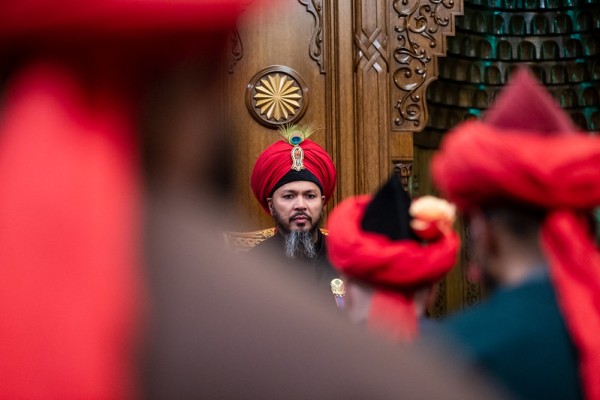
Recently, I have delved into the profound wisdom of Yusūf Balasağuni (qs) taken from his masnavi entitled, Kutadğu Bilig or The Wisdom of Royal Glory. Yusūf the Khāṣṣ Ḥājib (qs), an honorific which translates roughly to “Chancellor”, was an 11th century writer and poet; a contemporary to Mahmud al-Kashghari and is the author of the oldest known literary work of what is known as Islamic Turkish literature, the Kutadğu Bilig. Its original form is a “long didactic” poem in what is known as the mirror-for-princes tradition and it was prepared for and presented to the reigning prince of Kashghar in 1069 CE, Tavghach Bughra Khan.
There are two connecting parts of the Kutadğu Bilig that I would like to cite. These segments of Yusūf Khāṣṣ Ḥājib’s (qs) masnavi are concerning three sets of pairs. These particular pairs are integral, and they meet, joining at a point. The first of the pairs are “wisdom and intellect”; the second “merit and demerit” and the third, “benefit and harm”. That joining component, the centerpiece that acts as the interconnecting item is, “the tongue”.
The reason this item stood out is because, not only did Yusūf Khāṣṣ Ḥājib (qs) address wisdom and intellect as it relates to speech prior to the main body of his mesnevi, but it is a topic which my own shaykh addresses regularly during his talks, often quoting the Holy Prophet (may Peace and Blessing be upon him) and warning against the folly of foolish speech. Likewise Yusūf Khāṣṣ Ḥājib (qs) expounds on man’s chief glory, wisdom and intellect saying,
Continue Reading »
Posted in Culture, History, Life, Religion, Sufism | Tagged Chaghatay, Intellect, Islam, Karakhanid, Kashghar, Kutadgu Bilig, Literature, Mirror for Princes, Speech, Wisdom, Yusuf Khass Hajib | 1 Comment »
A wizened sage, from beyond Ashsharq, a far-off Eastern land, had arrived in the village. His philosophical expositions were so abtruse and yet so tantalizing that the usual company in the teahouse soon became convinced that he could perhaps unveil for them the mysteries of life.
Nasreddin Hoja listed to him for a while. ‘You know,’ he said, ‘I have had experiences something like yours on your travels. I, too, have been a wandering teacher.’
‘Tell me something about it, if you must,’ said the elder, somewhat ruffled at the interruption.
‘Oh, yes, I must,’ said Nasreddin Hoja. He continued:
‘For instance, there was the trip which I took through Kurdistan. I was welcomed everywhere I went. I stayed at one dergah (sufi lodge) after another, where the dervishes listened eargerly to me. I was given free lodging at caravan-serais (roadside inns), fee food at teahouses. Everywhere the people were impressed by me.’
The old sage was becoming impatient at all this personal publicity. ‘Did nobody ever oppose anything you said, at any time?’ he asked curiously.
‘Oh, yes,’ said Nasreddin Hoja. ‘Once I was beaten up and put in the stocks, then driven out of town.’
‘Why was that?’
‘Well, you see, the people there happened to understand Turkish, the language I was doing my teaching in.’
‘What about the people who had welcomed you?’
‘Oh, they were Kurds; they have a language of their own. I was safe as long as I was with them.’ (Shah, 1993)
Posted in Humor, Nasreddin Hoja, Religion, Travel | Tagged Kurdistan, Kurds, Turkish | 3 Comments »
April 30, 2008 by Saifuddin
Last week, I had the opportunity to discuss one popular Muslim blogger’s most recent post prior to its publishing. And at the time, when he shared the idea for the post, I thought it would be one of the most important blog topics of Rabi al-Thani 1429. And after reading the post, I realized just how significant an issue it was.
In the post, Yursil of the Mind, Body, Soul blog discusses the phenomena of ‘Spiritual Ambition’. He touches on a subject that few people want to accept, let alone discuss, and that subject is spiritual rank. The ’spiritually elite’ is clearly identified as a reality in the Qur’an al-kerim and the Sunnat of the Holy Prophet (may Peace and Blessings be upon him) and his Companions (may Allah be Pleased with them) but is this a reality today?
Please pardon my rhetoric and absurdity, but this is exactly what some are implying by ignoring or rejecting varying degrees of spiritual excellence among mankind. But for one moment, lets imagine spiritual rank is a phenomenon unchallenged, how then is it measured and defined? Yursil makes his case in the segment below:
| For modern day people of faith, this may be a perplexing idea. Ambition?
Spirituality? Ambition inherently involves ranks and gain. And modern day spirituality has been the great ‘equalizer’, everyone has become the same. For Muslim literalists, this is even more true. They refuse to accept spiritual training in a manner which inherently depends on recognizing the spiritual superiority of ones teacher. For them, the questions become asinine repetitions of “How do you know that teacher is not going to hell fire? No one knows!” |
|
|
Posted in Blogs, Life, Religion, Thoughts | Tagged Ambition, Blogger, Islam, Muslim, Rank, Spirituality, Success | No Comments »